
Common Questions About Altitude Water Systems
Find clear, straightforward answers to the most common questions about Altitude Water and atmospheric water generation. From how our systems work to water quality, energy use, maintenance, and real-world applications, this page is designed to help you make informed decisions about water independence.
We’ve also included practical insights based on real deployments, so you can understand what to expect—before, during, and after installation.

Each Altitude Water Atmospheric Water Generator (AWG) is engineered to produce a specific volume of clean drinking water per day based on temperature, humidity, and model type. Below you’ll find the daily water-production capacity for each unit when operating under standard environmental conditions (80°F / 60% humidity):
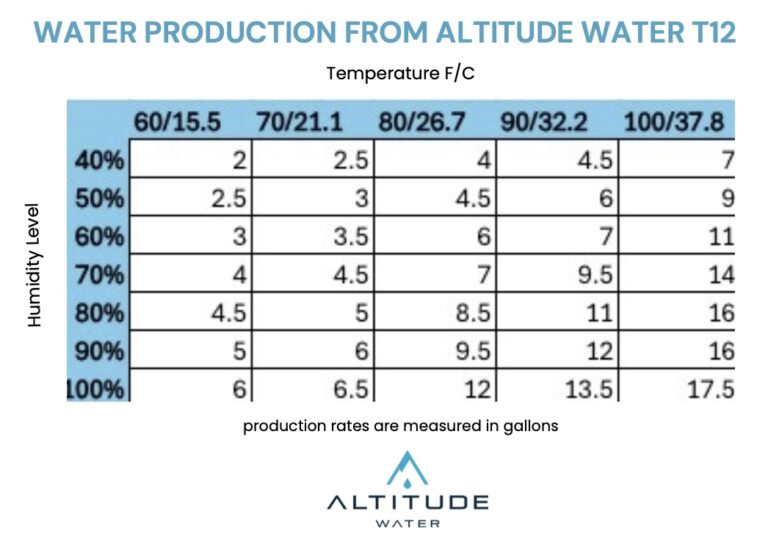
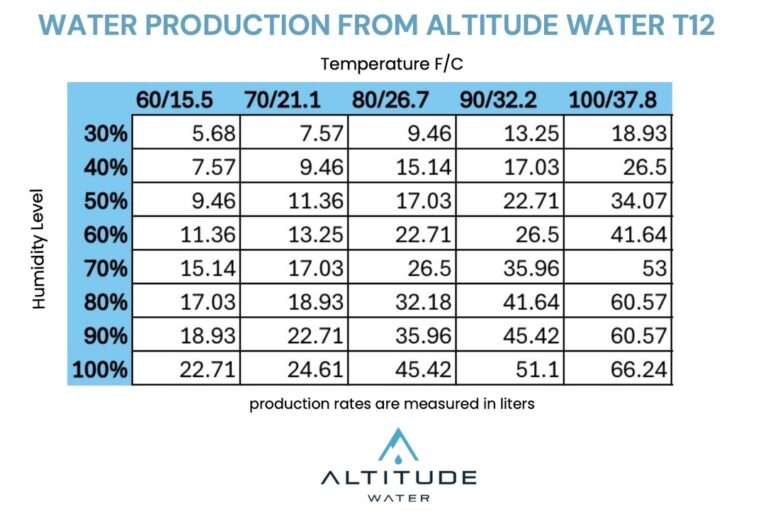
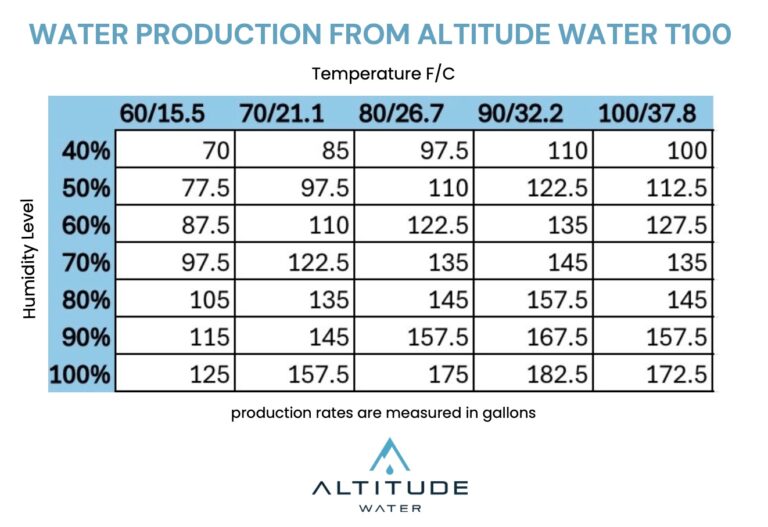
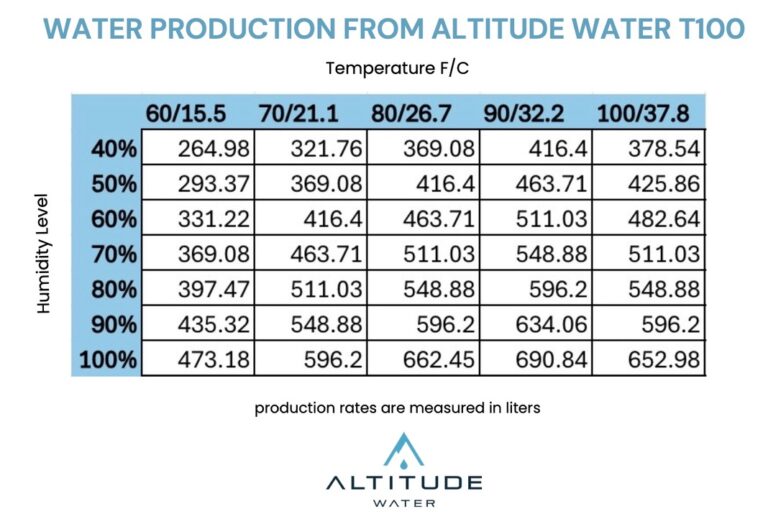
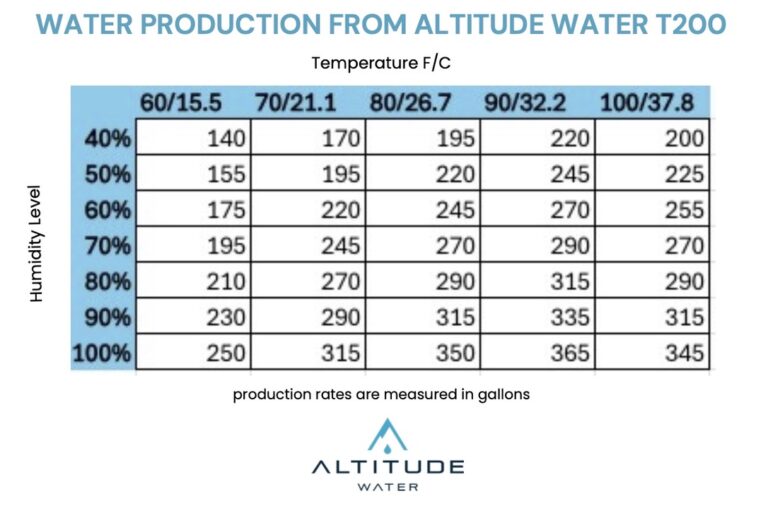
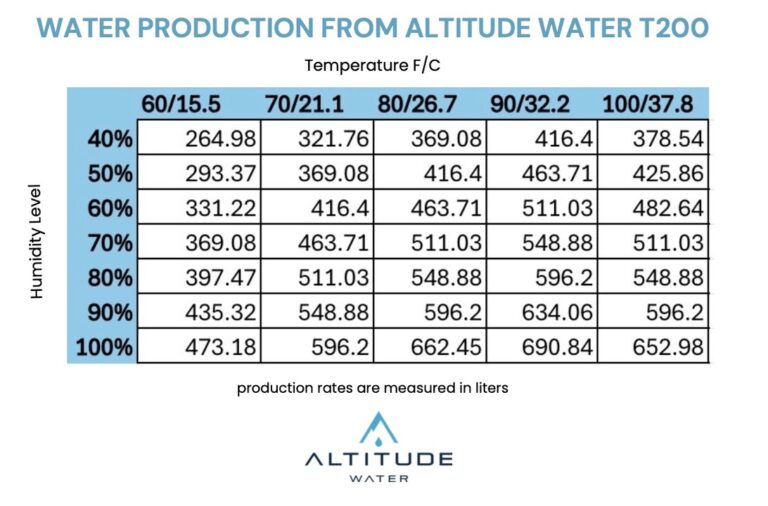
These values represent optimal output. Actual production may vary slightly based on real-time climate conditions, airflow, and placement.
Altitude Water’s purification process is modeled after how nature makes clean water, then enhanced with advanced technology to ensure exceptional safety, taste, and quality. Here’s the step-by-step process:
1. Advanced Air Filtration
The system begins by pulling in ambient air and passing it through a multi-stage air filtration system.
This removes:
-
Dust
-
Pollen
-
Particulates
-
Airborne contaminants
Only clean, filtered air proceeds into the water-generation chamber.
2. Water Generation (Condensation)
The filtered air is cooled so that moisture condenses into liquid water — the same process nature uses to form rain.
At this stage, the water is:
-
Pure, vapor-distilled quality
-
Free from PFAS, pesticides, heavy metals, chlorine, bacteria, and groundwater contaminants
-
Naturally clean with no minerals yet added
This is one of the cleanest starting points for drinking water.
3. Mineralization (Calcite Filter)
The first filter adds back beneficial minerals, including calcium and magnesium.
This step:
-
Raises alkalinity
-
Brings the pH to ~8.1 (naturally alkaline)
-
Improves taste, hydration, and balance
-
Restores essential minerals typically removed in distilled or RO water
4. Ozone Injection & Natural Dissipation
The system disinfects the water using ozone (O₃) — nature’s powerful oxidizer.
Ozone:
-
Eliminates bacteria, viruses, mold, and microorganisms
-
Naturally breaks down into oxygen (O₂) within ~20 minutes
-
Leaves no chemical residue
This keeps the internal tank and tubing sanitized at all times.
5. Taste & Odor Polishing (Carbon Block Filter)
A high-quality carbon block filter ensures the water is fresh and clean by removing:
-
Any remaining odors
-
Any trace taste from the environment or mineralization
This filter does not remove the healthy minerals added earlier.
Final Result
You get water that is:
-
Pure (starting as clean vapor)
-
Mineralized (calcium & magnesium)
-
Naturally alkaline (~pH 8.1)
-
Continuously disinfected
-
Fresh, clean, and exceptionally smooth-tasting
All with minimal maintenance and without relying on tap, wells, or municipal water sources.
Yes. Altitude Water systems can be customized for a whole-home installation, allowing you to supply clean, purified AWG water directly to selected fixtures throughout your home. However, a whole-home integration requires careful evaluation and planning to ensure compatibility, safety, and optimal performance.
1. System Evaluation
Before designing your setup, we will assess:
-
Your home’s existing plumbing system
-
Placement options for the AWG
-
Water demand across fixtures (kitchen, bathroom, laundry, etc.)
-
Storage needs and distribution requirements
This ensures the system is engineered correctly for your environment and usage.
2. Plumbing Compatibility
Altitude Water uses ozone-based purification, which is safe for certain plumbing types but incompatible with others.
Suitable for whole-home setups:
-
PEX
-
CPVC
-
PVC
Not recommended:
-
Copper piping, due to potential long-term reactions with ozone exposure.
If your home uses mixed plumbing materials, we can explore selective distribution or partial-home routing.
3. Custom System Design
Once compatibility is confirmed, we can design a personalized whole-home solution that may include:
-
Routing AWG water to specific fixtures (kitchen faucets, ice makers, refrigerator dispensers, etc.)
-
A dedicated storage tank
-
A booster pump or pressure regulator (if needed)
-
A closed, sanitized distribution loop to maintain purity
Every installation is fully custom to your layout, usage needs, and preferences.
4. Cost Considerations
Project cost depends on:
-
Plumbing configuration
-
Distance from the AWG to fixtures
-
Whether storage or pumping components are needed
-
The complexity of routing and design
A detailed quote is always provided after an in-home or virtual evaluation.
Altitude Water offers a cleaner, more sustainable, and more advanced approach to drinking water than traditional filtration systems. Instead of treating compromised water, our Atmospheric Water Generators create water directly from the air, beginning with pure, contaminant-free vapor.
Because we generate water — not filter it — there is:
-
No wastewater
-
No reliance on tap or well quality
-
No PFAS, heavy metals, pesticides, chlorine, or groundwater pollutants
-
No plastic bottles, no deliveries, and no waste
Our technology produces distilled-quality water that is purified, mineralized, and continuously protected through our EnviroGuard™ system, which uses ozone, UV sterilization, and multi-stage filtration to ensure exceptional safety and taste.
Compared to Reverse Osmosis (RO), Altitude Water provides:
-
Zero water waste
-
Higher purity from the start
-
No risk of residual contaminants
-
Consistent quality no matter where you live
-
A sustainable, energy-efficient solution for homes, businesses, schools, and emergency response
With Altitude Water, you’re not just filtering water — you’re achieving water independence, producing some of the cleanest drinking water on the planet right where you live.
Yes. Most residential and commercial RO systems waste significant amounts of water during the filtration process. While exact efficiency varies by model, the majority operate with a 4:1 or 5:1 rejection ratio—meaning:
-
For every gallon of purified water produced,
-
4 to 5 gallons are discharged as wastewater.
This wastewater contains a higher concentration of contaminants than the original source water because RO membranes trap impurities and flush them out in the reject stream. That concentrated water is then sent down the drain or into the environment.
Key Considerations
-
RO wastewater must be disposed of properly, which can complicate installation and increase overall system costs.
-
In regions with high nitrate levels, drought regulations, or strict wastewater management, RO systems can be difficult or impractical to use.
-
One of our California customers, for example, chose Altitude Water’s AWG instead of RO due to the high volume of nitrate-rich wastewater an RO system would have produced.
Additional Concerns
While RO filters out many contaminants, it is not 100% effective. Certain substances—such as PFAS (forever chemicals), VOCs, and trace pharmaceuticals—can still pass through some RO membranes. This means you may get cleaner water, but not necessarily contaminant-free water.
Both Reverse Osmosis (RO) systems and Altitude Water’s Atmospheric Water Generators (AWGs) provide cleaner drinking water—but they work in fundamentally different ways and solve different problems.
Reverse Osmosis (RO)
RO systems filter existing tap, well, or municipal water, pushing it through a semi-permeable membrane to remove contaminants.
Key considerations:
-
RO removes many impurities, but some chemicals—such as PFAS (forever chemicals), VOCs, and trace pharmaceuticals—can still pass through certain membranes.
-
RO does not eliminate the risk of biofilm buildup in storage tanks or tubing.
-
Because it depends on the original water source, RO is limited by the quality of the water coming in.
-
RO systems often waste several gallons of water for every gallon filtered.
Altitude Water
Altitude Water systems generate water directly from the air, beginning with pure water vapor, not compromised source water.
Key advantages:
-
The water starts as distilled-quality vapor, naturally free of PFAS, heavy metals, pesticides, chlorine, and groundwater contaminants.
-
Once condensed, the water is treated with the EnviroGuard™ purification system (ozone, UV, multi-stage filtration).
-
Essential minerals are reintroduced to create clean, balanced, great-tasting drinking water.
-
Because the water is produced fresh—inside a closed, self-sanitizing system—there is no risk of residual contaminants or biofilm in tanks or tubing.
The Key Difference
RO improves the quality of water you already have.
Altitude Water creates pure water from scratch.
RO is a filtration solution.
Altitude Water is a water-generation solution.
That means AWG-produced water is:
-
Source-independent
-
Naturally contaminant-free
-
Free from PFAS, heavy metals, pesticides, and groundwater pollutants
-
Freshly produced, not stored or transported
For customers who want the highest level of purity and independence from municipal or well-water issues, Altitude Water offers a more comprehensive, reliable, and future-proof solution.
In a typical indoor or non-coastal environment, Altitude Water’s Atmospheric Water Generators have an average lifespan of around 10 years. With proper maintenance—such as routine filter changes, scheduled cleaning, and basic system care—many units continue performing reliably well beyond the 10-year mark.
Our AWGs are engineered with:
-
High-quality stainless steel components
-
Commercial-grade internal systems
-
Durable, long-life parts designed for continuous operation
In normal conditions, customers can expect consistent, long-term performance and excellent reliability, making AWGs a sustainable and cost-effective water solution for homes, businesses, and community facilities.
Coastal environments are tough on any outdoor equipment. Air conditioners near the ocean often last less than five years due to constant salt exposure, especially when maintenance is inconsistent. Salt air corrodes coils, cabinets, and internal components quickly.
Altitude Water AWGs, however, are built differently.
Engineered for Durability
Our units use high-grade 304 stainless steel, corrosion-resistant hardware, and protective coatings designed specifically to withstand harsh, marine-exposed environments.
Better Longevity with Proper Care
With routine cleaning and basic maintenance, AWGs can significantly outlast typical coastal equipment. Many customers located just steps from the shoreline report multi-year performance with no corrosion issues.
Proactive Care Makes the Difference
Regular:
-
Wiping down stainless surfaces
-
Rinsing away salt buildup
-
Inspecting for early signs of wear
…all help maintain long-term durability.
In short, while traditional outdoor equipment like air conditioners often struggle in coastal conditions, Altitude Water’s AWGs are engineered to endure, and proper care ensures they deliver exceptional longevity even in salt-heavy environments.
Altitude Water AWGs are built with high-grade, corrosion-resistant materials designed to perform well in coastal environments. With proper care, units installed directly on or near the shoreline have operated for many years with no signs of corrosion or performance decline.
However, longevity near the ocean depends on two key factors:
1. Routine Maintenance
Regular cleaning and surface protection dramatically extend the life of the machine. Wiping down exterior stainless-steel surfaces and reducing salt buildup helps preserve the finish and hardware long-term.
2. Local Environmental Conditions
Areas with heavy salt spray, constant trade winds, or high humidity require more frequent maintenance. Even marine-grade materials benefit from consistent care in these harsher environments.
When maintained properly, customers in coastal locations can expect multi-year performance and long-term reliability from their Altitude Water system. Neglecting maintenance, on the other hand, can shorten the lifespan—as salt is extremely corrosive when left unmanaged.
With proper care, your AWG will remain durable, dependable, and corrosion-resistant for many years, even in extreme coastal climates.
Coastal environments expose equipment to salt air, humidity, and corrosive conditions, which can impact any appliance over time. Altitude Water’s AWGs are engineered with high-grade 304 stainless steel and corrosion-resistant components, but proper care will significantly extend the life and performance of your machine.
To protect your system in ocean-exposed locations, we recommend the following best practices:
1. Regular Exterior Cleaning
Wipe down all stainless-steel surfaces weekly using a high-quality stainless-steel cleaner and polish.
-
This removes salt residue
-
Adds a protective barrier
-
Helps reduce long-term corrosion
2. Use of High-Quality, Marine-Durable Materials
While our units are built with 304 stainless steel hardware and cabinets, even marine-grade materials benefit from routine care in high-salt environments. Consistent cleaning ensures maximum durability.
3. Fresh Water Rinse (When Possible)
If the machine is exposed to heavy salt spray or windborne salt:
-
Lightly rinse the exterior with fresh water
-
Allow it to dry or wipe it down completely
This simple step prevents salt crystals from settling and causing surface wear.
4. Proactive Maintenance & Inspections
Check the exterior and accessible components regularly to catch early signs of rust, wear, or buildup.
A little routine maintenance goes a long way in preserving:
-
Machine longevity
-
Performance consistency
-
Aesthetic appearance
-
Overall corrosion resistance
With proper care, Altitude Water AWGs perform exceptionally well in coastal and high-humidity environments, delivering continuous clean water even in the harshest conditions.
Altitude Water’s Atmospheric Water Generators typically produce water with an average pH of 8.1, placing it in the alkaline range. This naturally elevated pH is a result of our multi-stage purification and mineralization process, which creates clean, balanced, great-tasting drinking water.
We are also currently testing advanced high-pH filter combinations that have consistently produced water with a pH level above 10 while maintaining excellent purity, stability, and taste. Once final testing is complete, these high-alkaline options will be available as an upgrade for customers who prefer enhanced pH levels.
In short, Altitude Water offers naturally alkaline water today, with high-alkaline enhancements coming soon.
The indicator for acidity or alkalinity is known as the pH value. A pH value of 7 means a substance is neutral, water with a pH lower than 7 is considered acidic and with a pH greater than 7 water is considered alkaline. The normal range for pH in surface water systems is 6.5 to 8.5. The range in a Altitude Water AWG is 7.6 to 8.1.
There are two ways to raise the ph in water: ionization and mineralization.
Ionization- Here is the definition from Wikipedia- Ionization, is the process by which an atom or a molecule acquires a negative or positive charge by gaining or losing electrons, often in conjunction with other chemical changes. The resulting electrically charged atom or molecule is called an ion. Ionization can result from the loss of an electron after collisions with subatomic particles, collisions with other atoms, molecules and ions, or through the interaction with electromagnetic radiation.
This doesn’t sound so natural to us.
We raise our ph nature’s way by adding minerals Calcium and Magnesium to our water.
The bottom line is we used nature’s way to make the purest, alkaline, highest oxygenated water- and bottle it in glass and sustainable packaging for your body and the environment. It is why we say we make water with technology licensed from Mother Nature. We guarantee you will taste and feel the difference.
Altitude Water’s AWGs consistently produce cleaner, fresher, and more reliable drinking water than bottled water—and at a competitive long-term cost.
Quality Comparison
Bottled water often comes from:
-
Municipal sources (filtered tap water)
-
Aged groundwater that can contain microplastics or trace contaminants
-
Plastic bottles that may leach chemicals, especially in heat
With Altitude Water, you get:
-
Water that is filtered at the molecular level
-
Zero microplastics, zero PFAS, and zero chemical leaching
-
Freshly generated water, not water that has traveled or sat in storage
-
Purification that far exceeds EPA and bottled-water standards
Every drop is produced on-site, then continuously disinfected using Altitude Water’s EnviroGuard™ system, including ozone, UV sterilization, and multi-stage filtration for consistent purity.
Cost Comparison
Bottle companies spend heavily to:
-
Pump or extract water
-
Filter and bottle it
-
Package it in plastic
-
Ship heavy pallets long distances
-
Store it and distribute it nationwide
These costs are built into every bottle you buy.
Altitude Water eliminates:
-
Plastic bottling
-
Packaging waste
-
Long-distance shipping
-
Warehouse storage
-
Distribution markups
This means the cost of AWG water becomes far more economical over time, especially for:
-
Homes wanting daily water independence
-
Businesses, schools, gyms, and hospitality
-
Disaster readiness or off-grid communities
-
Remote locations where bottled water is expensive to deliver
Sustainability Benefits
Choosing AWG water also means:
-
No plastic waste
-
No microplastics in your drinking water
-
No fuel-burning trucks transporting water across states or oceans
-
A dramatically smaller carbon footprint
You’re not just saving money over time—you’re consuming water that’s better for your body and better for the planet.
Ozone (O₃) is a naturally occurring gas made up of three oxygen atoms. Unlike regular oxygen (O₂), ozone carries an extra oxygen atom, which makes it a powerful oxidizer — meaning it can break down and destroy microorganisms such as bacteria, viruses, mold, and other pathogens.
For more than 100 years, ozone has been used in water treatment systems around the world. It is one of the strongest and most effective broad-spectrum disinfectants available and is recognized as safe and effective by the FDA and the United States Public Health Service.
How Altitude Water uses ozone inside the machine
Altitude Water’s AWGs generate ozone on demand using a Corona Discharge ozone generator, which mimics the way ozone is created in nature during lightning storms — by applying an electrical charge to oxygen.
Inside the machine:
-
Ozone is created in small, controlled amounts only when needed.
-
It is not stored in a tank; instead, it is immediately infused into the water reservoir.
-
Once ozone completes its job of disinfecting the water, it naturally reverts back to O₂ (regular oxygen), leaving no chemical residue or aftertaste.
Why this matters
This process ensures your drinking water remains:
-
Continuously purified
-
Free from bacteria, viruses, and organic contaminants
-
Fresh-tasting and safe
-
Chemically clean, with no additives or preservatives
In short, ozone treatment is a natural, powerful, and chemical-free way to keep Altitude Water’s atmospheric drinking water pure, safe, and consistently high-quality.
Altitude Water’s EnviroGuard™ purification system is specifically engineered to eliminate microorganisms — including bacteria, viruses, mold, and biofilms — ensuring your water is consistently safe to drink.
A key part of this process is Ozone (Nature’s Cleanser), a proven water-treatment method used for more than 100 years worldwide. Ozone effectively destroys microorganisms on contact and is officially recognized by the United States Public Health Service as a standard and highly effective form of water purification.
In addition to ozone treatment, our AWGs include:
-
UV sterilization to neutralize microbes
-
Advanced filtration to remove particulates and organic matter
-
Closed-loop sanitation to keep stored water constantly fresh
Independent lab testing of Altitude Water’s atmospheric-generated water shows that it is extremely clean, consistently exceeding EPA drinking water standards — including microbial safety thresholds.
With EnviroGuard™, you can trust that every drop your machine produces is pure, fresh, and hygienically safe.
Absolutely — and this is one of the biggest advantages of Atmospheric Water Generators (AWGs). When moisture in the air condenses, it naturally transitions from vapor to liquid, leaving behind airborne contaminants, pollutants, allergens, smoke particles, and chemicals that cannot convert into water. This means the condensation process itself creates an inherently pure base water.
Altitude Water enhances this natural purification through our EnviroGuard™ multi-stage air and water filtration system, which includes:
-
Advanced air purification to filter the air before it enters the machine
-
Condensation-based separation, which naturally excludes most contaminants
-
UV sterilization, removing bacteria, viruses, mold, and bio-organisms
-
Activated carbon filtration to improve taste and remove VOCs
-
Final-stage purification capable of filtering particulate matter smaller than 0.01 microns
The result is clean, safe, great-tasting drinking water that meets or exceeds global drinking water standards — without relying on pipes, wells, or aging infrastructure.
So even if the air around you contains smoke, dust, pollen, or pollution, Altitude Water’s AWG technology ensures the water produced is consistently pure, safe, and reliable.
Yes. There are approximately 3.8 quadrillion gallons of water in the atmosphere at any given time, and this supply is constantly replenished through the natural hydrologic cycle. This means there is more than enough moisture in the air to produce fresh drinking water every single day, even in regions with lower humidity.
Altitude Water’s Atmospheric Water Generators (AWGs) are engineered to capture this renewable atmospheric moisture and turn it into clean, safe drinking water, providing a reliable and sustainable water source for homes, businesses, disaster relief, and off-grid communities.
Because the atmosphere continually regenerates water vapor, AWGs offer:
-
Daily water production in a wide range of climates
-
A renewable, drought-proof water supply
-
Independence from wells, pipes, or municipal systems
-
A safe alternative to contaminated or limited groundwater sources
In short, the air around us holds far more water than we could ever use, making atmospheric water generation a dependable solution for everyday water independence.
This scenario is not possible. Atmospheric Water Generators cannot—and will never—remove enough moisture from the air to affect the environment.
Here’s why: The Water Cycle Makes It Impossible
Earth’s hydrologic cycle continuously replenishes atmospheric moisture through:
-
Evaporation from oceans, lakes, rivers, and soil
-
Transpiration from plants
-
Weather patterns that redistribute humidity globally
At any given time, there are 3.8 quadrillion gallons of water in the atmosphere, and this amount is constantly refreshed. Humans cannot meaningfully reduce this volume.
AWGs Use a Tiny, Insignificant Amount
Atmospheric Water Generators pull only a microscopic fraction of naturally occurring humidity—far less than:
-
Air conditioners
-
HVAC systems
-
Dehumidifiers
-
Refrigeration units
-
Industrial cooling towers
These have been operating for decades with zero impact on global humidity levels.
No Environmental Risk
Using AWGs does not:
-
Deplete atmospheric moisture
-
Change weather patterns
-
Affect rainfall
-
Alter climate conditions
In fact, the amount of water pulled by all AWGs worldwide combined is so small that it isn’t measurable on a global scale.
The Bottom Line
We have no less water in the atmosphere today than we did before air conditioning, refrigeration, or AWG technology existed. The water cycle replaces atmospheric moisture faster than humans could ever remove it.
Atmospheric water generation is completely safe, renewable, and environmentally neutral.
No — not at all. Extracting water from the atmosphere is completely safe and has zero negative impact on the environment.
How We Use Atmospheric Moisture
The atmosphere contains 3.8 quadrillion gallons of water at any given time, constantly replenished by the natural hydrologic cycle.
Every day, humidity is condensed using:
-
Home dehumidifiers
-
HVAC systems
-
Air conditioners
-
Refrigeration systems
-
Car cooling systems
These devices pull moisture from the air the same way AWGs do — but without using the water. With an AWG, that same moisture is simply collected instead of discarded.
Once the water is consumed, any unused water eventually returns to the environment through evaporation — completing the natural cycle.
Environmentally Safer Than Traditional Water Sources
Using atmospheric water is actually far more sustainable than pulling water from:
-
Groundwater wells
-
Municipal systems
-
Depleted aquifers
In states like Florida, excessive groundwater pumping has caused:
-
Aquifer depletion
-
Land subsidence
-
Saltwater intrusion into drinking water wells
-
Rising contamination concerns
AWGs avoid these issues entirely because they don’t extract from the earth — they simply use moisture already circulating in the air.
The Bottom Line
✔ No depletion of natural water reserves
✔ No impact on rivers, lakes, or aquifers
✔ No risk of saltwater intrusion
✔ Fully aligned with the natural water cycle
✔ One of the most sustainable ways to produce drinking water
Atmospheric water generation is a clean, renewable, and environmentally responsible solution — far safer for the planet than traditional water extraction.
Yes, the water is absolutely pure, safe and clean, as well as great tasting. The water that is produced starts out pure as it is the vapor/humidity in the air that converts from a gas form to a liquid form; rather than dirty, contaminated ground water that needs to be purified. The purification system that keeps the water pure (EnviroGuard) is extremely effective and efficient and utilizes multiple safeguards especially Ozone to oxidize and eradicate any bacteria that tries to form in stored water. Ozone is 35 times more powerful than chlorine and can kill pathogens (harmful organisms) in seconds rather than minutes. Ozone was discovered in 1840 and by the 1890’s was recognized as a safe and effective oxidizing agent for water purification.
Ozone is also naturally occurring (a gas naturally produced on our planet) where chlorine is a chemical that is left in the water for you to consume. Finally, ozone converts into oxygen so you are drinking the purest oxygenated water on the market.
Altitude Water Atmospheric Water Generators (AWGs) pull moisture from the air and turn it into clean drinking water using a process inspired by how nature creates rain.
Here’s the simple breakdown:
1. Air Intake & Filtration
The machine draws in ambient air and passes it through advanced air filters. This removes dust, pollen, and airborne contaminants before the water-generation process begins.
2. Condensation (Just Like Clouds)
The filtered air moves across specially designed, food-grade coated coils.
This is where the magic happens:
-
The coils cool the air
-
Moisture condenses into liquid water
-
Because of the food-grade coating, the water never touches metal, preventing contamination and preserving purity
This is similar to how water vapor in the atmosphere turns into raindrops — only cleaner and fully controlled.
3. Collection & Purification
Once condensed, the water enters the internal tank and is treated with the EnviroGuard™ purification system, which includes:
-
Ozone disinfection
-
UV sterilization
-
Multi-stage filtration
-
Mineralization for balanced taste and alkalinity
4. Storage & Dispensing
The water is kept fresh, continuously sanitized, and mineral-balanced until dispensed.
You get pure, clean, great-tasting water, produced right where you live — no pipes, wells, or municipal systems required.
Other articles have been published revealing that some bottled water is really only reprocessed tap water. Some government studies have shown over 30% of the bottled water tested to be unsafe for humans.
Again, here is a good article about where most bottled water comes from- “Therefore, their assertion about contaminants in bottled water relates to the approximately 45% of bottled waters on the market that are from municipal water sources.
- The Truth About Bottled Water- Fox News- October 24, 2015-
https://www.foxnews.com/health/the-truth-about-bottled-water</a >
Finally, Trident Water bottles in sustainable packaging (glass and wood crates) and not in plastic. This is better for you and the environment. We have all seen the data about what these plastic bottles are doing to our planet. Additionally, the plastic bottles release chemicals into the water that are not safe for human consumption.
Yes — absolutely. Water produced by an Altitude Water Atmospheric Water Generator (AWG) is among the cleanest, purest, and safest drinking waters available.
Here’s why:
1. Starts Pure — Stays Pure
Altitude Water systems generate water directly from the air, beginning as clean vapor. This means the water never touches:
-
Pipes
-
Groundwater
-
Aging municipal systems
-
Plastic bottling lines
-
Trucking or storage environments
It starts pure—and remains pure inside a closed, self-sanitizing system.
2. Bottled Water Isn’t What Most People Think
Many popular bottled water brands are simply filtered municipal tap water.
Even “spring water” can vary widely in:
-
Purity
-
Mineral levels
-
Contaminant exposure
-
Microplastics content
Plastic bottles can also leach chemicals—especially when exposed to heat during storage or transport.
3. Tap Water Contains Allowable Contaminants
Municipal tap water often contains legal but concerning levels of:
-
PFAS (forever chemicals)
-
Chlorine and disinfectant byproducts
-
Pharmaceuticals
-
Lead from pipes
-
Microplastics
-
Pesticide runoff
RO and filters try to reduce these contaminants—but they were never present in Altitude Water to begin with.
4. Superior Safety & Taste
Altitude Water uses its EnviroGuard™ purification system, adding essential minerals and maintaining freshness with ozone and UV protection.
The result is:
-
Pure
-
Mineral-balanced
-
Naturally alkaline
-
Smooth-tasting
-
Free from plastics and contaminants
5. Better Packaging, Better Health
Altitude Water is stored in glass, not plastic—preventing chemical leaching and keeping the water clean, safe, and flavorful.
Bottom line:
Altitude Water begins with pure vapor, adds essential minerals, protects it continuously, and avoids the contaminants found in tap, well, or bottled water.
It’s cleaner than bottled water, safer than tap water, and engineered to be one of the highest-quality drinking waters available anywhere.
Numerous articles have been written warning about the amount of impurities and contaminates that are in public drinking water supplies as well as the vulnerability of public water supplies to terrorist attack. We have spent centuries following the engineer’s creed that the solution to pollution is dilution. Our aquifers and reservoirs are now contaminated with harmful chemicals, pesticides and pharmaceuticals.
In addition to the water itself, the piping system of municipal sources are antiquated and in most cases over a century old (Remember Flint Michigan?). This also increases the opportunity for contaminates to be in your water through the infrastructure.
There are also numerous water main breaks that result in municipal water not being able to deliver water to your home. Fort Lauderdale was recently without water for 48 hours due to a water main break.
Here are just a few recent articles about tap and well water in the State of Florida:
- Florida Drinking Water ranks 2nd worst in the nation May 3, 2017
https://www.abcactionnews.com/news/region-hillsborough/report-finds-florida-drinking-water-ranks-2nd-worst-in-nation</a > - Top Ten States with the Worst Public Tap Water in the United States November
16,2018.
https://www.multipure.com/purely-social/science/top-10-states-worst-public-water-ratings-united-states/</a > - Study: Arsenic In Drinking Water Of Several States, Including Florida, Damages
Hearts Of Young Adults May 7, 2019.
https://miami.cbslocal.com/2019/05/07/study-arsenic-in-drinking-water-of-several-states-including-florida-damages-hearts-of-young-adults/</a >
The only way to be certain that your drinking water is pure and safe and that you have access to safe water- no matter if the municipal system goes down- is to have it delivered to your home by Altitude Water.